
By all means, please contribute to the language's culture and/or history.
| Progress 96% | ||||||||||||||||||||||||||||||||||||||||||||||||||||||||||||||||||||||||||||||||||||||||||||||||||||||
|
| ||||||||||||||||||||||||||||||||||||||||||||||||||||||||||||||||||||||||||||||||||||||||||||||||||||||
|
||||||||||||||||||||||||||||||||||||||||||||||||||||||||||||||||||||||||||||||||||||||||||||||||||||||
| Ringwa Ringwap | |||
|---|---|---|---|
| Type | |||
| Alignment | |||
| Nominative-accusative | |||
| Head direction | |||
| Final | |||
| Tonal | |||
| No | |||
| Declensions | |||
| Yes | |||
| Conjugations | |||
| Yes | |||
| Genders | |||
| No | |||
| Nouns decline according to... | |||
| Case | Number | ||
| Definiteness | Gender | ||
| Verbs conjugate according to... | |||
| Voice | Mood | ||
| Person | Number | ||
| Tense | Aspect | ||
General information[]
This language was simply constructed as an experiment, and for fun.
Phonology / Writing system[]
The writing system of Ringwa is called "skritap ringwara" (lit. writing of Ringwa). There is no capital/small letter distinction.
Consonants[]
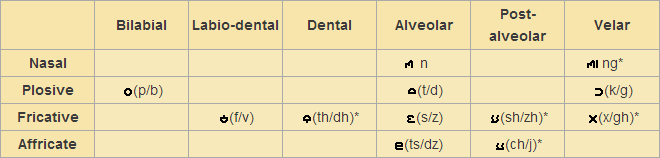 |
Consonant pairs (?/?) are unvoiced-voiced pairs.
IPA symbols: ŋ (ng), θ (th), ð (dh), ʃ (sh), ʒ (zh), x (x), ɣ (gh), tʃ (ch), dʒ (j)
Vowels[]
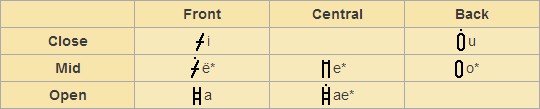 |
IPA symbols: ə (e), ɛ (ë), æ (ae), ɔ (o)
L and R[]
R represents an alveolar tap (IPA: ɾ).
L represents an alveolar lateral approximant. (IPA: l)
 |
Alphabet[]
 |
Romanized:
a, i, o, e, ai, oi, wa,
æ/ae, ë, u, r, l, ya, yo, wo,
p, k, t, s, ts, š/sh, tš/ch, x, þ/th, f, n,
b, g, d, z, dz, ž/zh, dž/j, ğ/gh, ð/dh, v, ng,
ra, ap, dya, kya, ël, un, ri, æz.
IPA:
/a/, /i/, /ɔ/~/o/, /ə/, /ai/, /ɔi/, /wa/,
/æ/, /ɛ/~/e/, /u/, /ɾ/, /l/, /ja/, /jɔ/, /wɔ/,
/p/, /k/~/c/, /t/, /s/, /ts/, /ʃ/, /tʃ/, /x/~/ç/, /θ/, /f/, /n/,
/b/, /g/~/ɟ/, /d/, /z/, /dz/, /ʒ/, /dʒ/, /ɣ/~/ʝ/, /ð/, /v/, /ŋ/,
/ɾa/, /ap/, /dja/, /cja/, /el/, /un/, /ɾi/, /æz/.
Cyrillic:
а, и, o, ә, аи, oи, уа,
ӓ, е, у, р, л, я/ья, ё/ьё, уo,
п, к, т, с, ц, ш, ч, х, ѳ, ф, н,
б, г, д, з, ѕ, ж, џ/дж, ґ, дѳ, в, нк/нг,
ра, ап, дья, кья, ел, ун, ри, ӓз.
Throughout this guide, the romanized script will be used.
Orthography for foreign/loan words[]
- "pn" is pronounced /m/.
- "xğ" is pronounced /h/.
- "pğ","tğ" and "kğ" represent /pʰ/, /tʰ/ and /kʰ/ respectively.
- "sl" and "tsl" represent /ɬ/ and /tɬ/ respectively.
- "zl" and "dzl" represent /ɮ/ and /dɮ/ respectively.
Phonotactics[]
Almost all 2-consonant clusters are allowed, but exactly one of the two must be a stop. /ts/, /dz/, /tʃ/ and /dʒ/ must be written with the proper symbol (not as a pair of symbols).Clusters must have the same voicing throughout, otherwise they are pronounced according to "Orthography for foreign words". When two vowels are next to each other, pronounce a glottal stop between them, except if one of them is /ɾ/ or they are in a diphthong (/ai/, /ja/, /ɔi/, /jɔ/, /wa/, /wɔ/). Only plosives, /n/ or /ŋ/ can precede /w/, and written /ŋ/ must occur at the end of a syllable. Also, the following sound changes take place (in this order):
- /n/ before a velar consonant is pronounced /ŋ/ except across a word boundary.
- /k/, /g/, /x/ and /ɣ/ before /j/ is pronounced /c/, /ɟ/, /ç/ and /ʝ/ respectively.
- Any string of 2 or more /ɾ/ must be pronounced as an alveolar trill /r/.
Grammar[]
There are three types of word in Ringwa: Objects, Numbers, and Relations.
Objects[]
These correspond to other languages' nouns, verbs, adjectives and adverbs. Each object has a number of forms to determine what part of speech it is, but some words do not have an adverb form.
Objects can have these forms:
Noun: (e.g.) Weight
Verb: To weigh
Performer: (Weigh-er) Balance/scale
Adjective: Heavy
Adverb: Heavily
Object Conjugation/Declension[]
The affixes are applied in the order they are presented in below (top-bottom), if required. A case must be added for nouns and a tense must be added for verbs. Markers must be included on adjectives and adverbs. Table note: The number in parentheses is a "group". Only one member of any group can be added, and things with no group specified are on their own.
Stems with no affixes added are verb infinitives.
| Purpose | Parts of speech | Required | Primary start/end | If primary creates illegal cluster |
|---|---|---|---|---|
| Adjective marker | Adjectives | No (0) | æz- | æza- |
| Adverb marker | Adverbs | No (0) | gëz- | gëza- |
| State of being (-ness/-hood) | Nouns, adjectives | No | -ku | -eku |
| Performer | Nouns | No | gar-r | ge-er |
| Combined nominative-accusative case (Direct case) | Nouns, gerund verbs | Yes (1) | -p | -ap |
| Genitive case | Nouns, gerund verbs | Yes (1) | -ra | -era |
| Dative case | Nouns | Yes (1) | -ng | -ëng |
| Locative case | Nouns | Yes (1) | -kya | -ëkya |
| Instrumental case | Nouns, gerund verbs | Yes (1) | -gur | -egur |
| Paucal (2-5) | Nouns, gerund verbs, number adjectives | No (2) | gh- | ghë- |
| Plural(6+) | Nouns, gerund verbs, number adjectives | No (2) | zh- | zhë- |
| Collective (All) | Nouns, gerund verbs | No (2) | sk- | skë- |
| Past tense | Verbs, adjectives (participle) | Yes (3) | wa- | wap- |
| Present tense | Verbs, adjectives (participle) | Yes (3) | ya- | yap- |
| Future tense | Verbs | Yes (3) | cha- | chap- |
| Perfect aspect | Verbs | No (4) | -ag | -kag |
| Continuous aspect | Verbs | No (4) | -ts | -ëch |
| Gerund | Verbs | No | nya- | nyap- |
| Passive voice | Verbs | No | be- | ber- |
| Imperative mood (for commands) | Verbs | No | ch- | che- |
| Comparative | Adjectives, adverbs | No (5) | -yar | -rr |
| Superlative | Adjectives, adverbs | No (5) | -yast | -st |
Numbers[]
These are like numbers in other languages, except they are in base 20 (dën). They are a special case of Objects, with a predetermined definition (with "x" being the value):
- Noun: x itself
- Verb: To multiply by x / To x-tuple (double, triple, quadruple, ...)
- Adjective: Having a count of x (paucal/plural) xth (otherwise)
- Adverb: Done x times
- Performer: A device/person whose purpose is to multiply by x
Number words:
| # | Lat. Ringwa | # | Lat. Ringwa | # | Lat. Ringwa | # | Lat. Ringwa |
|---|---|---|---|---|---|---|---|
| 0 | zheru | 12 | dhudëxab | 205 | vædënri | 2017 | sëdëx dënri |
| 1 | un(e) | 13 | tradëxab | 206 | shëdënri | 2018 | otedëx dënri |
| 2 | dhu | 14 | vadëxab | 207 | sëdënri | 2019 | nudëx dënri |
| 3 | tra | 15 | vædëxab | 208 | otedënri | 2020 | dën dënri |
| 4 | va | 16 | shëdëxab | 209 | nudënri | 20202 | dhudënri dënri |
| 5 | væ | 17 | sëdëxab | 2010 | dëx dënri | 20203 | tradënri dënri |
| 6 | shë(k) | 18 | otedëxab | 2011 | undëx dënri | 202020 | dën dënri dënri |
| 7 | së(t) | 19 | nudëxab | 2012 | dhudëx dënri | Negative (-x) prefix | dya- |
| 8 | ot(e) | 20 | (une) dën | 2013 | tradëx dënri | Reciprocal (1/x) prefix | dhi- |
| 9 | nu(n) | 400 | dhudën | 2014 | vadëx dënri | Half (1/2) | dhyo |
| 10 | dëx(e) | 8000 | tradën | 2015 | vædëx dënri | One twentieth (1/20) | dhën |
| 11 | undëxab | 204 | vadën | 2016 | shëdëx dënri |
dën dënri dënri (twenty-twenty-powerof-twenty-powerof) = 202020 is about the 3.5th root of a googolplex (1010100)
Number operation suffixes:
All operations are written after their inputs, so "two plus one" in Ringwa would be un dhu waba (lit. "one two added")
Adding: -ba or -abe
Multiplying: No suffix, just concatenate
Exponentiation: -ri. Note that the exponent is said and written before the base.
Relations[]
These correspond to other languages' articles, particles and prepositions. They do not inflect.
| Ringwa | English/Description |
|---|---|
| un | Indefinite article: "a" or "an". Also the number "one". |
| l | Definite article: "the". |
| del | Expresses the topic of something. Like English "about". |
| dya | Negation (not ~). Can also be prefixed to another relation ("negating" it). Use "dyar" to negate a word starting with a vowel. |
| tsi | English "above" or "over". Can be negated for "below" or "under". |
| dëks | English "to the right of". Can be negated for "to the left of". |
| frën | English "in front of" or "before". Cannot be negated. |
| bax | English "behind" or "after". Cannot be negated. |
| suro | English "surrounding". Can be negated for "inside". |
| roda | English "around". This is different from suro in that it implies rotational movement. Cannot be negated. |
| prox | English "near". Can be negated for "far". |
| anu | English "among" or "amid". Can be negated for "separate/different from". |
| dir | English "next to", can refer to either left or right, but no other directions. |
| fu | English "by", but only used for expressing ownership. |
| depi | English "despite", "except for". Can be negated for "including". |
Word order[]
- Adjectives and adverbs come after the noun/verb they are describing.
- Subjects and agents come before objects
- Verbs must be after their subject and object (SOV order). This reduces ambiguity.
- Relations can only come after nouns.
Vocabulary[]
| No. | English | Rom. Ringwa |
|---|---|---|
| 1 | I | yop |
| 2 | you (singular) | tup |
| 3 | he | ërap |
| 4 | we | ghëyop/zhëyop |
| 5 | you (plural) | ghëtup/zhëtup |
| 6 | they | ghëra/zhëra |
| 7 | this | ëstap |
| 8 | that | nap |
| 9 | here | ëstëkya |
| 10 | there | nakya |
| 11 | who | twarap |
| 12 | what | këp |
| 13 | where | këkya |
| 14 | when | tëp |
| 15 | how | zena |
| 16 | not | dya |
| 17 | all | skæp |
| 18 | many | dzæ |
| 19 | some | ghæ |
| 20 | few | (paucal) |
| 21 | other | otre |
| 22 | one | unap |
| 23 | two | dhup |
| 24 | three | trap |
| 25 | four | vap |
| 26 | five | væp |
| 27 | big | æzda |
| 28 | long | æzdhir |
| 29 | wide | æzafërn |
| 30 | thick | æzdist |
| 31 | heavy | æzwote |
| 32 | small | dya æzda |
| 33 | short | dya æzdhir |
| 34 | narrow | dya æzafërn |
| 35 | thin | dya æzdist |
| 36 | woman | perswap |
| 37 | man (adult male) | perswop |
| 38 | man (human being) | persup |
| 39 | child | dyapersup |
| 40 | wife | dhuwap |
| 41 | husband | dhuwop |
| 42 | mother | trawap |
| 43 | father | trawop |
| 44 | animal | bëstip |
| 45 | fish | piskap |
| 46 | bird | avyop |
| 47 | dog | pëgup |
| 48 | louse | — |
| 49 | snake | kolup |
| 50 | worm | urnap |
| 51 | tree | arbop |
| 52 | forest | skarbolp |
| 53 | stick | barp arbora |
| 54 | fruit | kænidap arbora |
| 55 | seed | ofop arbora |
| 56 | leaf | folyap |
| 57 | root | terap arbora |
| 58 | bark | kortizhap arbora |
| 59 | flower | florap |
| 60 | grass | folyap terrara |
| 61 | rope | kordap |
| 62 | skin | pëlap |
| 63 | meat | — |
| 64 | blood | — |
| 65 | bone | — |
| 66 | fat | — |
| 67 | egg | ofop |
| 68 | horn | — |
| 69 | tail | — |
| 70 | feather | — |
| 71 | hair | — |
| 72 | head | — |
| 73 | ear | — |
| 74 | eye | — |
| 75 | nose | — |
| 76 | mouth | — |
| 77 | tooth | — |
| 78 | tongue | — |
| 79 | fingernail | — |
| 80 | foot | — |
| 81 | leg | — |
| 82 | knee | — |
| 83 | hand | — |
| 84 | wing | — |
| 85 | belly | — |
| 86 | guts | — |
| 87 | neck | — |
| 88 | back | — |
| 89 | breast | — |
| 90 | heart | — |
| 91 | liver | — |
| 92 | drink | — |
| 93 | eat | — |
| 94 | bite | — |
| 95 | suck | — |
| 96 | spit | — |
| 97 | vomit | — |
| 98 | blow | — |
| 99 | breathe | — |
| 100 | laugh | — |
| 101 | see | — |
| 102 | hear | — |
| 103 | know | — |
| 104 | think | — |
| 105 | smell | — |
| 106 | fear | — |
| 107 | sleep | — |
| 108 | live | — |
| 109 | die | — |
| 110 | kill | — |
| 111 | fight | — |
| 112 | hunt | — |
| 113 | hit | — |
| 114 | cut | — |
| 115 | split | — |
| 116 | stab | — |
| 117 | scratch | — |
| 118 | dig | — |
| 119 | swim | — |
| 120 | fly | — |
| 121 | walk | — |
| 122 | come | — |
| 123 | lie | — |
| 124 | sit | — |
| 125 | stand | — |
| 126 | turn | — |
| 127 | fall | — |
| 128 | give | — |
| 129 | hold | — |
| 130 | squeeze | — |
| 131 | rub | — |
| 132 | wash | — |
| 133 | wipe | — |
| 134 | pull | — |
| 135 | push | — |
| 136 | throw | — |
| 137 | tie | — |
| 138 | sew | — |
| 139 | count | — |
| 140 | say | — |
| 141 | sing | — |
| 142 | play | — |
| 143 | float | — |
| 144 | flow | — |
| 145 | freeze | — |
| 146 | swell | — |
| 147 | sun | — |
| 148 | moon | — |
| 149 | star | — |
| 150 | water | — |
| 151 | rain | — |
| 152 | river | — |
| 153 | lake | — |
| 154 | sea | — |
| 155 | salt | — |
| 156 | stone | — |
| 157 | sand | — |
| 158 | dust | — |
| 159 | earth | — |
| 160 | cloud | — |
| 161 | fog | — |
| 162 | sky | — |
| 163 | wind | — |
| 164 | snow | — |
| 165 | ice | — |
| 166 | smoke | — |
| 167 | fire | — |
| 168 | ash | — |
| 169 | burn | — |
| 170 | road | — |
| 171 | mountain | — |
| 172 | red | — |
| 173 | green | — |
| 174 | yellow | — |
| 175 | white | — |
| 176 | black | — |
| 177 | night | — |
| 178 | day | — |
| 179 | year | anop |
| 180 | warm | — |
| 181 | cold | — |
| 182 | full | — |
| 183 | new | — |
| 184 | old | — |
| 185 | good | dyar æzamal |
| 186 | bad | æzamal |
| 187 | rotten | — |
| 188 | dirty | — |
| 189 | straight | — |
| 190 | round | — |
| 191 | sharp | — |
| 192 | dull | — |
| 193 | smooth | — |
| 194 | wet | — |
| 195 | dry | — |
| 196 | correct | vërid |
| 197 | near | prox |
| 198 | far | dya prox |
| 199 | right | æzdërch |
| 200 | left | dyar æzdërch |
| 201 | at | (locative)/a |
| 202 | in | (locative) |
| 203 | with | (instrumental)/lë |
| 204 | and | ë |
| 205 | if | ru |
| 206 | because | — |
| 207 | name | nomep |
Example text[]
The alphabet:
 |
The Universal Declaration of Human Rights, Article 1:
 |
| All human beings are born free and equal in dignity and rights. They are endowed with reason and conscience and should act towards one another in a spirit of brotherhood. |
| skë-persu-p æz-liber æz-ikwal ë digniti-kya rëkta-kya ë be-ya-nat. zh-ëra-p rëson-gur konsyans-egur ë be-wa-da | zh-ëra-p zh-otre a ya-dëbe axto mod-ëkya brëtherku-ra ë. |
| COL-'human being'-DIR ADJ-'freedom' ADJ-'equality' 'and' 'dignity'-LOC 'right'-LOC 'and' PASS-PRES-'born'. PL-'he'-DIR 'reason'-INS 'conscience'-INS 'and' PASS-PST-'give' PL-'he'-DIR PL-'other' PRES-'must' 'act' 'way/method'-LOC 'brotherhood'-GEN 'and' |